
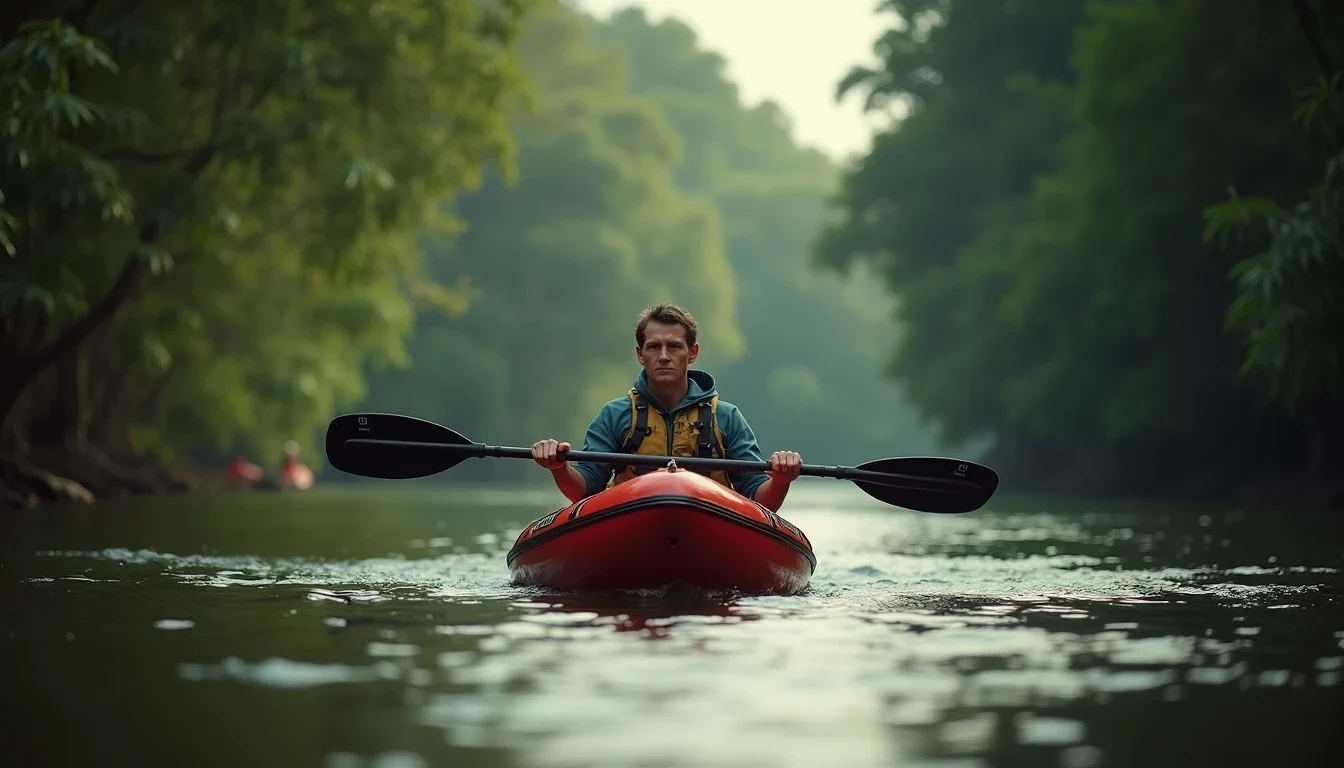
Some people watch a man paddle an inflatable kayak through crocodile water and see adventure tourism. Ash Dykes wants you to see a live broadcast of what happens when you commit to a plan so completely that turning back costs more than pushing forward. The Welsh explorer launched onto the Sangha River on 8 October from Nola in the Central African Republic, bound 700 kilometres downstream to Mossaka in the Republic of the Congo. He faces three to four weeks in an environment where a capsized kayak, a contaminated water bottle, or a single bureaucratic delay can end the entire enterprise. This is Mission 1 of Project 6, six extreme expeditions across six environments in twelve months, with barely a fortnight to recover between each. The audience is watching in real time. Some have already commented that he might be dead by now.
Dykes has earned the right to be taken seriously. Five world records sit behind him: solo across Mongolia, the full length of the Yangtze, the length of Madagascar. The Congo Basin operates on different logic. Nile crocodiles, territorial hippos, forest elephants, western lowland gorillas, snakes, spiders, malaria, dengue, parasites, waterborne illness, extreme heat and humidity, and medical help measured in days rather than hours. The wildlife makes for dramatic footage. Dykes has been explicit that it is not what frightens him. Isolation, disease, and the complete absence of margin for error occupy that category. This reveals how experienced operators allocate attention: they do not waste cognitive resources on theatrical risks.
What broke before the launch
The expedition was already compromised before Dykes touched water. A bag containing essential kayak pumps disappeared. Visa complications forced an unplanned and lengthy detour. Border checkpoints consumed time and patience. Fallen trees blocked roads entirely. The team endured a rain-soaked motorboat ride just to reach the departure point. Each obstacle demanded immediate solution without the infrastructure that makes problem-solving routine in developed contexts. There was no courier service for replacement gear, no administrative hotline, no roadside assistance.
This sequence mirrors what happens to entrepreneurial ventures in emerging markets. The plan assumes functional logistics. Reality delivers missing equipment, regulatory friction, and environmental blockages. The operator who treats these as exceptions to be lamented stalls out. The operator who builds them into the baseline model keeps moving. Dykes did not postpone the launch until conditions stabilised. He sourced alternatives, cleared paths, and proceeded with degraded but sufficient capability. The kayak entered the water on schedule.
The local guide as competitive advantage
Dykes travels with a UK videographer and, critically, a local guide. The documentation serves the audience. The guide serves survival. Knowledge of river currents, animal behaviour, safe passage points, and local customs cannot be downloaded or improvised. It must be purchased through relationship and respect. This is a practical recognition that expertise is geographically distributed, and the operator who refuses to pay for it pays instead in errors.
South African entrepreneurs operating across provincial or national borders understand this implicitly. Market entry in unfamiliar territory without local intelligence produces expensive misjudgments. The guide does not diminish Dykes’s achievement; the guide makes it possible. The same applies to hiring, partnerships, and advisory structures. The question is not whether you can eventually learn what locals already know. The question is whether your timeline permits the education.
Mental models for sustained pressure
Extreme exploration generates substantial commentary about physical endurance. The psychological architecture receives less attention. Dykes has spoken about breaking the 700-kilometre distance into smaller targets: reach that bend, cover twenty kilometres today, execute the immediate paddle stroke correctly. This is cognitive load management. The human mind under prolonged stress defaults to catastrophic projection. The antidote is not optimism but granularity. Focus on the next concrete action, execute it, repeat.
The routine serves a similar function. Eating, sleeping, packing, purifying water, maintaining equipment. Structure in chaos prevents the paralysis that accompanies overwhelming uncertainty. Dykes’s five previous world records provide a personal reference library. He has been here before, in versions. The memory of prior survival reinforces current capacity. For entrepreneurs, this translates directly to experience as the irreplaceable asset. First-time founders face identical market conditions with fewer internal resources to draw upon. The disadvantage is real and often decisive.
Transferable discipline for high-stakes decisions
The parallels between Dykes’s operational environment and entrepreneurial decision-making are specific enough to be useful. Rigorous contingency planning for critical resources and supply chains. Strategic risk assessment that prioritises probability and impact over drama. Adaptability when initial plans fail. Clear long-term vision combined with achievable short-term objectives. Mental fortitude calibrated not to eliminate fear but to function despite it.
The “zero margin for error” framing is not hyperbole for the Congo. A single serious mistake is terminal. Most business contexts permit more forgiveness, which is precisely why operators in those contexts become sloppy. The discipline of operating as if the margin were thinner than it is produces better decisions. Dykes cannot afford to discover that his water purification failed. The entrepreneur who waits to discover that their cash flow assumption failed has already lost too much time.
The cost of extreme ambition
Project 6 demands twelve months of continuous output with minimal recovery. The body does not fully repair. The mind does not fully reset. Each mission begins with accumulated deficit. This is the true cost that the live documentation reveals: not the crocodiles, not the diseases, but the compound interest of sustained exertion without adequate restoration. Dykes has chosen this deliberately. The audience should understand what they are witnessing.
For individuals seeking to sharpen their own thinking, the applicable question is not whether to emulate the extremity. It is whether your current ambitions are structured to permit the recovery that permits longevity, or whether you are running a personal Project 6 without acknowledging the debt you are accumulating. The kayak moves downstream regardless. The operator chooses whether to notice the fatigue setting in.